

Bottom Line: Despite its pervasive technical deficiencies and anachronistic engine, Fallout: New Vegas stands as an unparalleled benchmark for player agency and narrative depth within the action RPG landscape.
Fallout: New Vegas is not merely a game; it is a philosophical treatise on choice and its ramifications, wrapped in the familiar iconography of post-apocalyptic Americana. Its narrative architecture is less a linear path and more a fractal labyrinth, where every decision, no matter how seemingly minor, creates ripples that can fundamentally alter the course of the Mojave’s future. Unlike many open-world RPGs that present an illusion of choice, New Vegas’s player agency is palpably real. Aligning with a faction isn't a mere cosmetic designation; it locks off entire quest lines, opens others, and paints a target on the player’s back from opposing forces. The game dares to present nuanced, often unpalatable choices, compelling players to weigh the pragmatic against the ethical, the short-term gain against long-term consequence. There are no unequivocally "good" or "evil" factions; the NCR, for all its democratic ideals, is a bureaucratic behemoth prone to imperial overreach, while Caesar's Legion, for all its barbarity, offers a brutal form of order to a chaotic world. Mr. House, a technocratic autocrat, promises stability at the cost of individual liberty. Navigating these ideological minefields forms the true core of the gameplay loop, culminating in a climactic struggle for the Hoover Dam where the player's accumulated allegiances determine the fate of the entire region.
This unparalleled depth extends to its world-building and character development. The Mojave Wasteland feels lived-in, its diverse settlements and irradiated expanses each telling a story of survival and desperation. The writing is consistently sharp, often darkly humorous, and frequently profound, fleshing out a cast of memorable characters who transcend mere quest-givers. Companions, in particular, are not just interchangeable combat drones but individuals with distinct personalities, backstories, and often their own compelling quest arcs that further deepen the player’s investment in the narrative tapestry. The "Companion Wheel" may seem a minor UI enhancement, but it underscores the game's commitment to making its diverse cast integral to the experience, allowing for quick tactical adjustments and deep lore exposition.
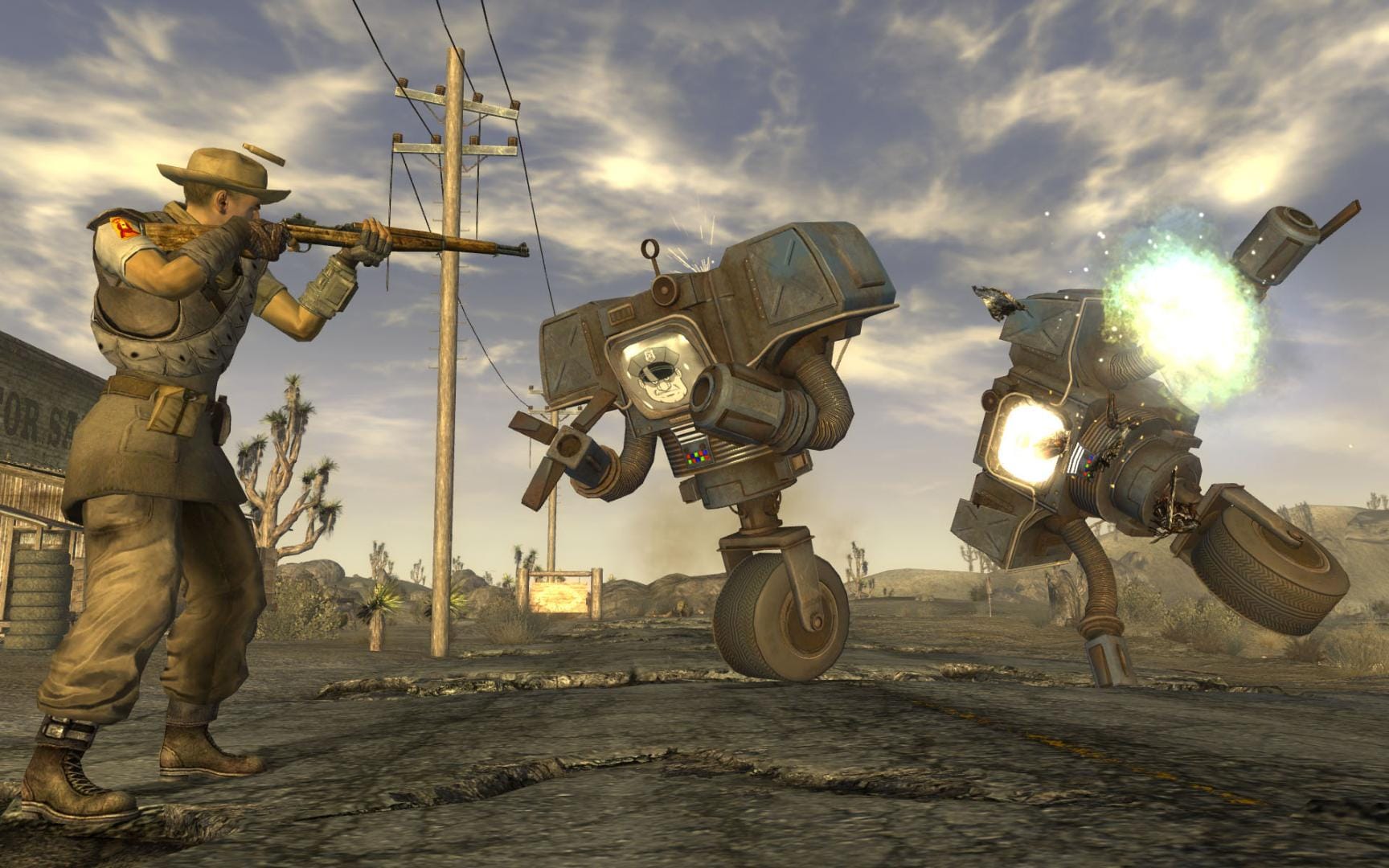
Yet, this narrative brilliance is inextricably linked to, and occasionally undermined by, the game’s glaring technical shortcomings. The reliance on Bethesda’s aging Gamebryo engine, even at its release, was a contentious point. Visually, New Vegas was already behind the curve, its character models rigid, its environments often drab, and its animations clunky. More critically, the engine was a hotbed of bugs, glitches, and frequent crashes, particularly at launch. These issues, while largely addressed over time through patches and an indefatigable modding community, initially created significant onboarding friction, demanding patience from players who wished to plumb its narrative depths. Combat, too, often feels less like precise engagement and more like an exercise in managing jank, a consequence of the engine’s inherent limitations rather than a deliberate design choice. Despite these structural flaws, the underlying strength of Obsidian’s writing and systemic design consistently shines through, proving that a meticulously crafted narrative and unparalleled player agency can triumph over technical deficiencies.