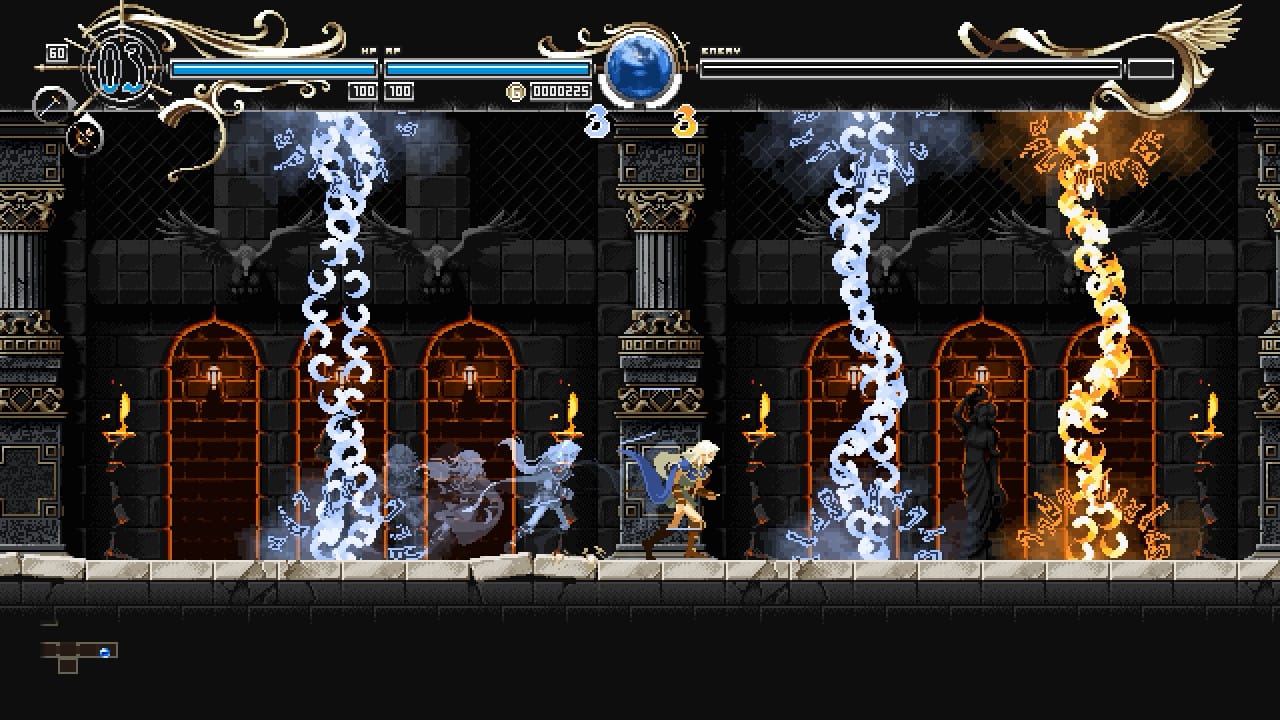



Bottom Line: A gorgeous, precision-built Metroidvania that trades sprawl for craft — six hours of near-flawless sprite work and a genuinely smart elemental combat system, undercut only by boss fights that never quite ask enough of you.
The Gameplay Loop
Most Metroidvanias treat elemental affinity as a lock-and-key nuisance: fire enemy, bring fire sword, move on. Deedlit treats it as a rhythm instrument.
The Sylph/Salamander toggle is bound to a single input and carries no cooldown penalty worth respecting, which means the game can build encounters that expect you to flip states two or three times inside one exchange. A boss telegraphs a fire sweep; you switch to Salamander, eat the hit at reduced cost, switch back to Sylph for the movement advantage during the punish window. It's the defensive logic of a parry system without the twitch tax of a parry system, and it makes the game legible to players who bounce off Souls-adjacent timing.
Then the healing economy layers on top and quietly changes everything. Because damage-dealing with your active spirit charges it toward a max-level HP regen, the optimal play is never to turtle. Retreat and you starve. The system creates forward pressure without ever writing "be aggressive" on the screen — it just makes cowardice unprofitable. That's real design confidence, and it's the reason the combat holds up across a full run despite a relatively shallow move set.
Where It Flattens Out
The bosses are the soft spot, and it's not close. Encounter design is readable — patterns are clear, tells are honest, and the elemental swap always has a correct answer. The problem is that the correct answer is usually the only answer, and it's rarely hard to find. Once you've internalized the swap logic in the first two hours, most fights resolve into pattern recognition rather than pressure. Players coming from Hollow Knight's Pantheon or the harder corners of the genre will finish bosses on the first or second attempt for most of the run. The higher difficulty modes address this by raising numbers, not by rewriting behavior, which is a patch rather than a fix.
Progression has a similar softness. The labyrinth is described as sprawling and interconnected, and structurally it is — but the critical path is considerably more linear than the marketing implies. Ability gates open in a near-fixed sequence. Sequence breaking is minimal. You will rarely be lost, which is either a mercy or a missing organ depending on your tolerance for cartography. Compared against the 1997 Castlevania that named the genre — the benchmark reviewers reached for repeatedly — this is a guided tour of a labyrinth rather than a labyrinth.
Onboarding and Friction
Here's the counterargument, and it's strong: this is the most approachable good Metroidvania of its generation. Onboarding friction is close to zero. There's no resource management, no punishing death loop, no obscure item interactions, no wiki dependency. Weapons swap instantly. The map is honest. A player who has never finished a game in this genre can finish this one, and finish it feeling competent rather than coddled.
Against a 5-to-8-hour runtime, that accessibility reads as intent, not compromise. Team Ladybug built something with almost no dead space — no padding corridors, no backtracking-as-content, no fetch quests inflating a completion counter. Every room does a job. The trade is that when the credits roll you'll want another six hours that don't exist, and the boss rush isn't a substitute for a second act.
The Story Layer
The amnesia framing is the oldest trick in the drawer, and the game knows it — it uses the setup as a delivery mechanism for lore rather than as a mystery worth solving. For Lodoss readers, the payoff is real: Mizuno's supervision produced continuity that fits, and the connective tissue to Diadem of the Covenant lands. For everyone else, the narrative is pleasant background radiation. Neither audience is badly served, but only one is actually being courted.